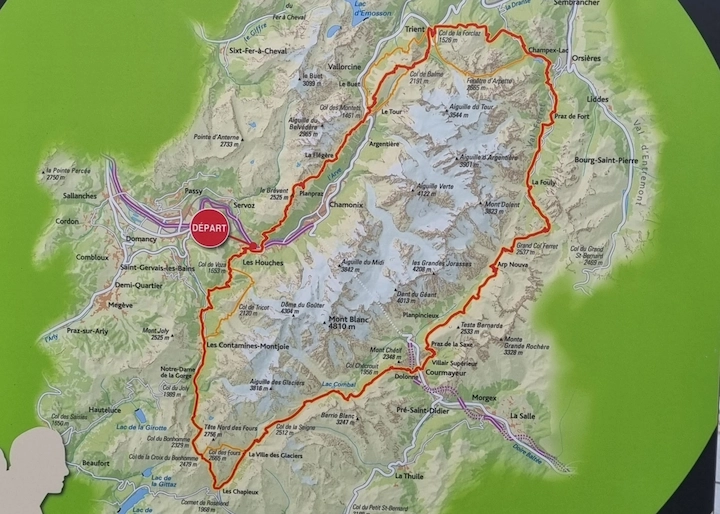
The Tour du Mont Blanc can be done clockwise or counterclockwise, the classic route. In addition to the bivouacking regulations by country and the best time to do the TMB, some elements should be considered before making your choice. To picture the route, explore the full TMB loop on the interactive map.
Choosing your direction based on the views
The Tour du Mont Blanc is full of breathtaking landscapes, offering magnificent views regardless of your walking direction. However, certain sections of the trail offer a unique perspective on major points of interest, varying depending on the orientation of your hike. While stopping and turning around remains an option to enjoy these views, the experience is not quite the same as naturally discovering them while progressing on the trail.
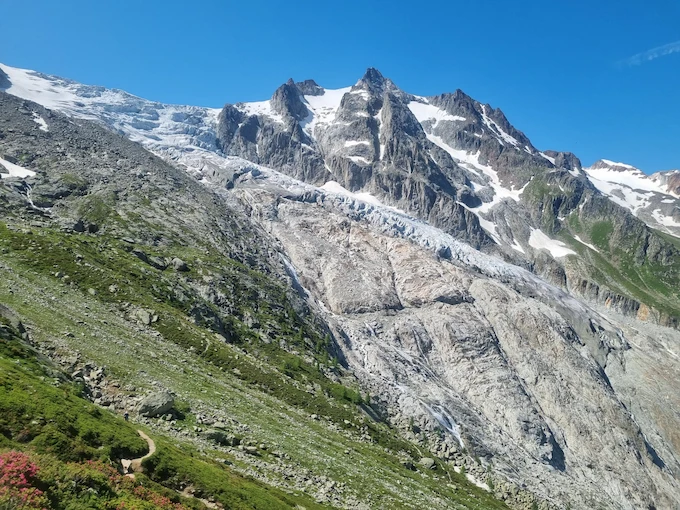
- Fenetre d’Arpette - Advantage Clockwise: The alternative route leading to the Fenetre d’Arpette, one of the most demanding on the Tour du Mont Blanc, offers a remarkable view of the Trient Glacier. Those who choose the clockwise direction are constantly drawn towards the Fenetre d’Arpette, with these majestic views dominating their path. In contrast, those taking the counterclockwise direction only capture these scenes at the top, turning around during their descent.
- Grand Col Ferret - Advantage Clockwise: On the Italian side of the Grand Col Ferret, the Val Ferret trail runs along the hillside, a true panoramic balcony over the Mont Blanc range in the words of the Aosta Valley tourism website. This spectacle is best enjoyed while descending the Val Ferret, which means hiking clockwise.
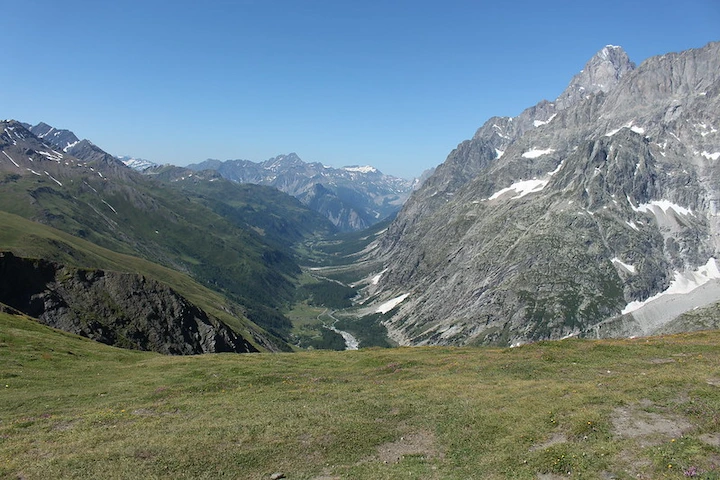
View of the Italian Val Ferret
- La Flégère to Brévent balcony - Advantage Counterclockwise: Between La Flégère and Les Houches, the trail follows a balcony facing the north side of the massif and passes over the summit of the Brévent. Counterclockwise, you have Mont Blanc in front of you all the way along the Chamonix valley.
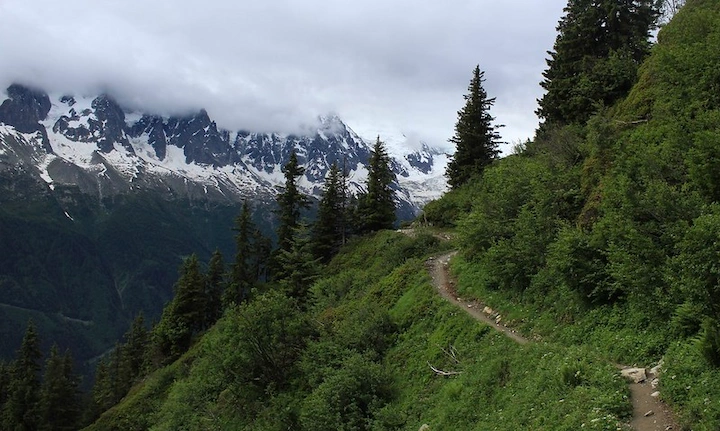
View of the Mont Blanc massif from the Grand Balcon Sud
Browse all our itineraries
Tour du Mont Blanc in 7 days
Stages, route & accommodations
Tour du Mont Blanc in 10 days
Stages, route & accommodations
Choosing your direction based on your physical condition
You may prefer to start your journey on flat sections or those with moderate slopes, ideal for shaking off rust from inactivity and reacclimating to the load of a backpack. If this preference applies to you, here are then the optimal directions from our selected starting points:
- Starting from Les Houches, both routes require significant effort from the beginning. Going clockwise, you climb from Les Houches (1,008 m3,307 ft) to the summit of the Brévent (2,525 m8,284 ft): we suggest heading for the Col de Voza instead, which is far less steep.
- Starting from Courmayeur, the effort is of the same order either way: towards the Rifugio Bertone counterclockwise, or via Dolonne and Plan Checrouit (where there is a cable car station) up to Maison Vieille the other way.
If you are concerned about the impact of descents on your knees or about your physical condition for next summer, it is useful to know that on the Tour du Mont Blanc many ascents and descents can be avoided using transport such as gondolas, cable cars, and buses.
Choosing your direction based on the crowd
The Tour du Mont Blanc enjoys great popularity among hiking enthusiasts, and it can be done with or without a guide. Espace Mont-Blanc counted around 75,000 hikers on the route in 2025, with days reaching 1,000 passages. The French hiking federation FFRandonnée puts it at 90,000 trekkers a year.
The TMB is “a victim of its own success”: the mayors along the route have agreed in principle on a charter that would make booking accommodation mandatory in summer, from spring 2027 (see our article on mandatory reservations in 2027). Choosing your direction remains a useful way to space out encounters, but it will no longer exempt you from booking. Here are some key elements to consider regarding the orientation of your itinerary taking into account the attendance of the trail:
-
Clockwise: By choosing to hike clockwise, you will benefit from regular moments of tranquility on the trail, conducive to establishing your own pace and mindfulness. This experience is explained by the fact that hikers moving in the same direction tend to form groups, as overtaking someone on narrow paths can be socially awkward. In contrast, briefly stepping aside to let those coming in the opposite direction pass is done naturally. Once you have passed a group of hikers who left from a specific accommodation, you enjoy a long period of calm before reaching the next cohort. Therefore, it is generally not necessary to leave your accommodation very early or stay late on the trail to enjoy moments of solitude.
-
Counterclockwise: It is the most classic and best waymarked direction; going clockwise, on the other hand, can help you find a bed in the refuges if your dates are not flexible. Leaving early in the morning from your accommodation can give you a significant lead over those who left from more distant places. However, by noon, convergence with other groups becomes inevitable, often placing you near other hikers. Don’t delay your start because of it: most storms break out between 2 and 5 PM.