Across the 170 km106 mi of the Tour du Mont Blanc, the answer to this question should not take long: the Italian section, between Courmayeur and the Grand Col Ferret, is without question the most spectacular stretch of the circuit. This is not a matter of taste - it is a matter of geography.
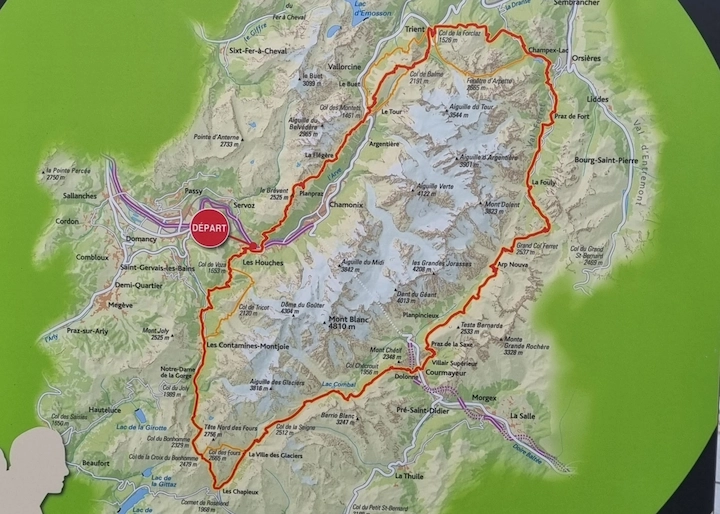
The TMB crosses three countries (France, Italy, Switzerland) and circumnavigates the Mont Blanc massif in the anti-clockwise direction, the classic one. Each side of the massif offers a different experience. Not all of them are equal. To place the sections mentioned below, view the complete route on the interactive map.
Why is the Italian section the most beautiful part of the TMB?
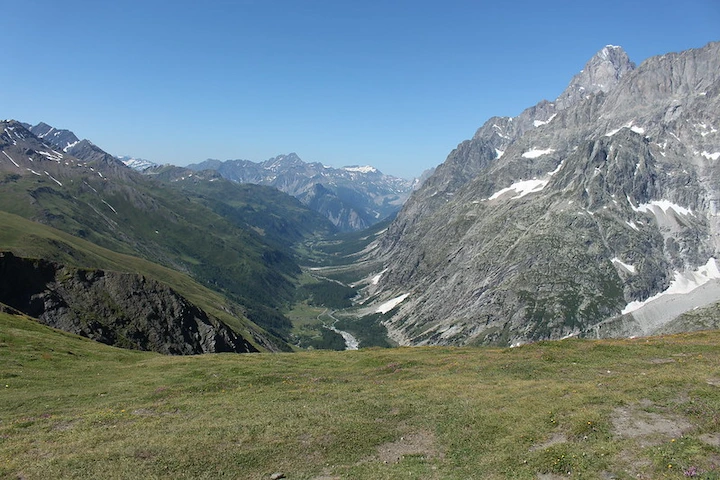
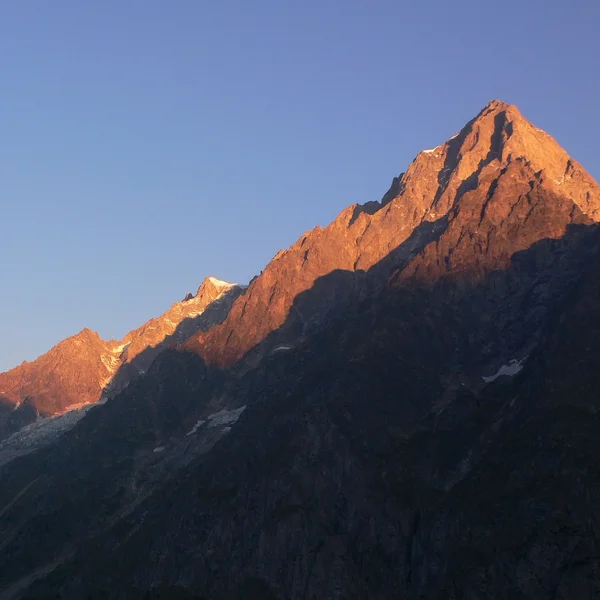
From Courmayeur to the Grand Col Ferret (2,536 m8,320 ft), the trail runs along the Italian Val Ferret over two solid days of hiking at our pace. The Aosta Valley tourism website describes it as a true panoramic balcony over the Mont Blanc range, from the Aiguille Noire de Peuterey to the Grandes Jorasses and Mont Dolent - towering walls of ice and rock that dominate the valley at a proximity found nowhere else on the circuit.
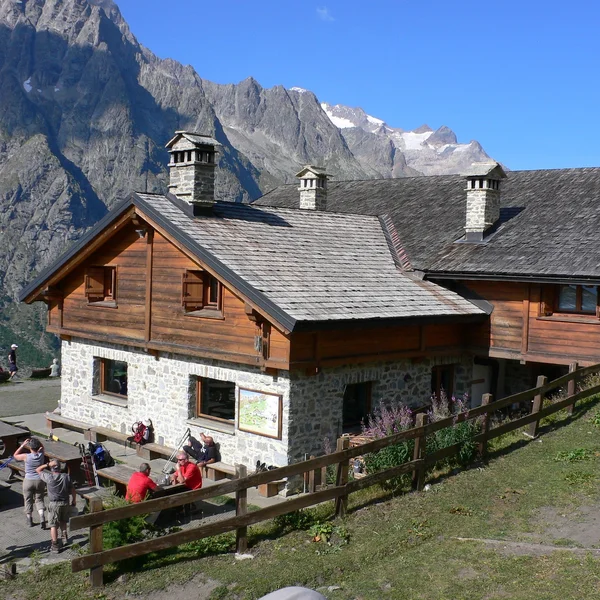
The centrepiece of this section is Rifugio Bonatti (2,025 m6,644 ft), perched on a ledge with a sweeping view down the entire Val Ferret and the Grandes Jorasses chain as a backdrop. The refuge describes itself as “set at the foot of the Grandes Jorasses, directly opposite magnificent Fréboudze glacier”, and the Aosta Valley stage description calls it “one of the epic places of the Tour du Mont Blanc” (translated from Italian). If you sleep in only one refuge on the entire circuit, make it this one.
The climb to the Grand Col Ferret from the refuge completes the section. On the Italian side, you look back over everything you have just crossed. On the Swiss side, the Swiss Val Ferret opens before you: at the top, “the view opens onto the great peaks of the Swiss side”.
The Swiss Val Ferret: solid but different
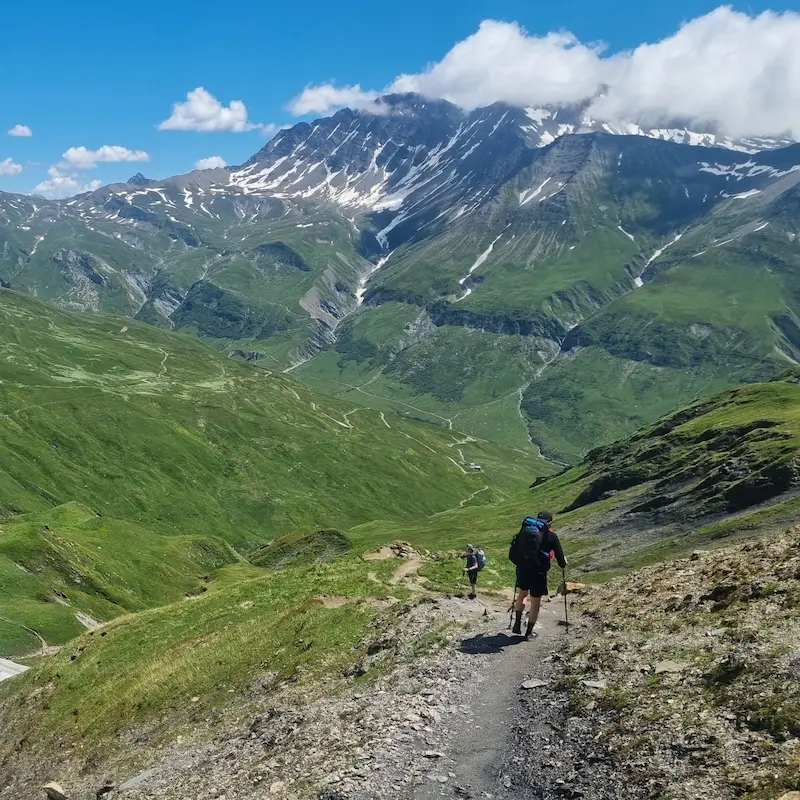
The descent from the Grand Col Ferret on the Swiss side down to Champex-Lac is long - 3 h 55 from the Elena refuge to La Fouly, then 4 h 10 to Champex (Aosta Valley stage descriptions) - and passes through more pastoral terrain - alpine meadows, streams, and scattered farms. It is beautiful, but with a gentler character than the Italian side: less vertical drama, less glacial ice in view. The standard trail via Champex is visually unremarkable by TMB standards.
The Fenetre d’Arpette: the variant that changes everything
If the standard Swiss section disappoints, the Fenetre d’Arpette (2,665 m8,743 ft) transforms it entirely. It is one of the most demanding variants on the TMB - from Champex-Lac to Trient, 14.6 km9.1 mi and 1,199 m3,934 ft of ascent, rated “difficult” by the Pays du Saint-Bernard tourist office - and by far the most beautiful day on the Swiss side of the circuit.
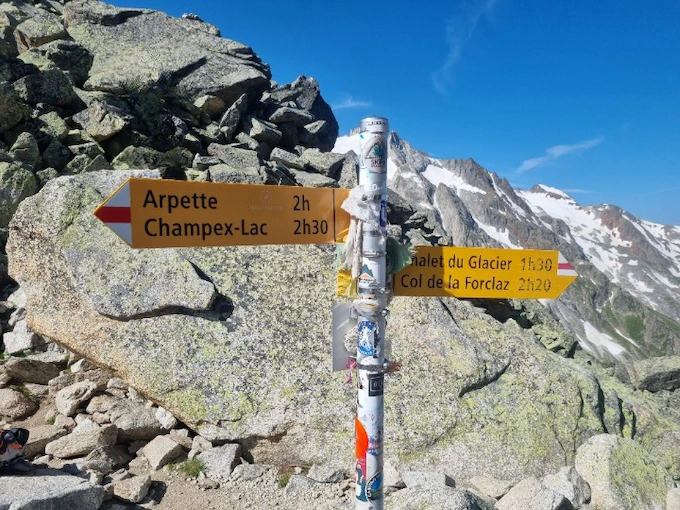
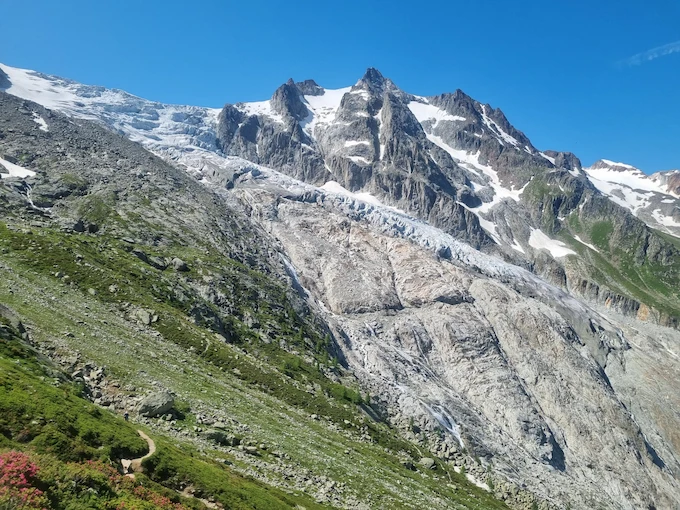
The trail climbs from Champex-Lac through the Val d’Arpette, first through forest then into increasingly steep boulder chaos, to the col at 2,665 m8,743 ft. The moment you tip over the other side is the most striking on the entire Swiss section: the Trient Glacier drops away below your feet, a tongue of ice wedged between vertical walls. The descent toward the glacier is steep and spectacular.
Weather dictates everything. Avoid this variant in bad weather, and know that snowfields can linger in June and early July. Check the forecast the day before and only commit in clear weather. If conditions are not right, fall back to the standard Champex route without hesitation.
The French side: two completely different experiences
The French section breaks into two very distinct stretches.
The Grand Balcon Sud, between La Flégère, the Brévent and Les Houches: the Aosta Valley stage description calls it a balcony “facing the north side of the massif” (translated from Italian). It is a panoramic trail with direct views of Mont Blanc and, from Lac Blanc, of the Mer de Glace. Spectacular on paper - but the Chamonix valley is heavily developed, cable-car infrastructure is visible throughout, and trail traffic during peak season is intense. The magic is real but comes with an asterisk.
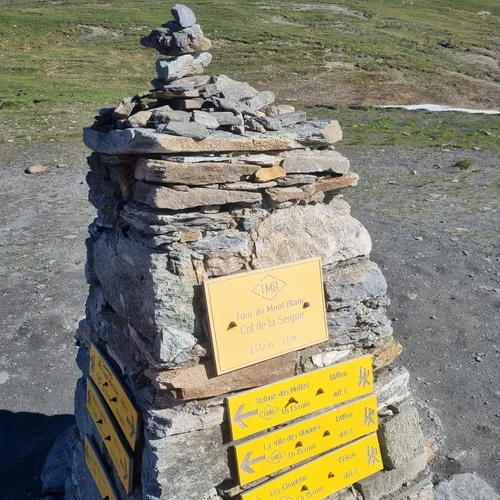
The section between Les Contamines and the Italian border - particularly the climb to the Col du Bonhomme (2,329 m7,641 ft) and the Col de la Seigne (2,591 m8,501 ft) - is the wildest stretch on the French side: sparse crowds outside the main stopovers, open alpine meadows. The ascent to the Col de la Seigne marks the crossing into Italy and opens “a spectacular view of the Italian side of the massif”, glaciers and needles included.
Which part of the TMB is the least spectacular?
The honest answer: the section around Champex-Lac and the Trient valley on the standard route (without the Fenetre d’Arpette). This stretch is largely forested, views of the massif are absent or partial, and it is hard to believe you are on the same circuit as the Italian Val Ferret. It is not unpleasant - it is actually a welcome rest - but if you are doing a shortened version of the TMB and need to cut something, this is where you cut without regret.
The Chamonix valley also deserves a mention: in our 10-day itinerary, the final stage, Chamonix - Les Houches, is purely logistical. It is not trekking - it is getting from A to B.
How to make the most of the best sections
If you are hiking the TMB with time constraints, here is the priority order to follow:
- Non-negotiable: The Italian Val Ferret (Courmayeur - Rifugio Bonatti - Grand Col Ferret). Do not cut this section under any circumstances. The 7-day TMB runs through the Italian Val Ferret to the Elena refuge.
- Highly recommended: The Col de la Seigne (see our guide to the passes of the Tour du Mont Blanc) and the wild sector between Les Contamines and Courmayeur.
- Do if you have the fitness: The Fenetre d’Arpette variant on the Swiss side. The 10-day TMB gives you the space to include it.
- Weather-dependent: The Grand Balcon Sud from Chamonix.